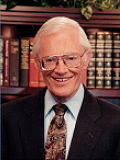

Saturday, 21 July 2007

The Bible and Corporal Punishment

This is Part 1 in a series by Samuel Martin. His website is www.biblechild.com.

It is my pleasure to write about this subject because it was the first real serious subject that I researched and presented my findings in book form under the title "Thy Rod and Thy Staff, They Comfort Me: Christians and the Spanking [or Smacking] Controversy." (For more details on my book, please see my website.)

When I first began to do the research for the book in 1996, it was at a time in my life when I was first beginning to exercise my theological muscles and venture out and formulate some of my own ideas. As I have always had a penchant for pastoral ministry (much more so than my father did), I wanted to write something and research a subject which allowed me to deal with serious social and theological questions, but to do so in a way according to how I was trained to present ideas; which was to look at the original texts with a view to help making those texts and their original meanings clearer. I pray that this is what I have done in my book.

My experience with this subject of Corporal Punishment

Like almost all children who grew up in the WWCG environment, corporal punishment was the normal way to "correct" children. Not only were children spanked at home, but they were also spanked in the WWCG school system.

I will talk about this more in a moment, but before that I want to recall one of my earliest memories because it relates to corporal punishment. I remember that I was with my family traveling in Switzerland in the mountains at Interlachen, a very high-elevated place something like 10,000 feet (3,250 Meters or so) above sea level. I remember in fact somehow being temporarily separated from my family and venturing quite close to the edge of the guardrail to look down the slope of the mountain. At that moment, I remember being grabbed from behind by a woman who I did not know. I can remember seeing the cliffs and seeing how far down it was. I could not have been more than four at the time.

The next thing I remember was seeing my parents. My mom was crying and I can't remember exactly what my father looked like. He was not one to cry really, but I do remember the spanking I received.

For me, I was not spanked much because I was pretty well behaved, but as many will I am sure remember growing up in the WWCG circles, little children were spanked and some were beaten badly. I can remember people commenting about how well behaved the children were, but I found that we grew up in an environment of fear. The slightest infraction, like making too much noise when you drank your milk, could merit a swat or swats. Really the environment was oppressive and dominative working to keep constant control of the children.

Even through all of this, I saw some amazing things when I was small. I had a friend who was about my age, maybe a year older. He and I were friends in England before I moved to the USA. He was so well behaved when he was in front of his parents, who beat the living day lights out of him if he transgressed even the most minor of infractions, but when he, who could not have been more than seven at the time, was not in front of mom and dad, I distinctively remember that he had a little toy gun that he played with far out in the garden where his mom and dad could not see it because toy guns in the WWCG were forbidden. Had his parents known that he had that toy gun, you can forget the forty lashes that the Bible mentions (St. Paul calls it Forty minus one); that kid would have been beaten to a pulp!

This example showed me early on that spanking does not engender righteous behavior. (I have a whole chapter in my book on this issue from a theological perspective.) It is a broken repented spirit that seeks to do right, not a broken backside!

I have one final small anecdote that I wish to share about my experience in the WWCG school system. The WWCG was a very hierarchical structure from the Pastor General down to his inner circle, to the regional leaders, to the local church down to the home. Men dominated the whole culture of the church.

My father was one who eventually got into a position where he was at levels in the Church where he was dealing with the Pastor General and his inner circle and this gave him lots of power in the organization. Dad never used that power in a wrong way because in the early days especially, he believed that he was serving God in His True Church on earth. Both of my parents were dedicated loyal members of the Church before I was born. Only in the seven years after I was born did my parents start to have their doubts based upon what happened to them.

Now, with dealing with these inner circle people, my father obtained a status within the denomination that he did not have heretofore. He was writing, speaking and teaching and was recognized as being an excellent authoritative teacher. Some of this status that my father held also came into my life even though I was only six years old at the time. I am the only son of three children and I am the youngest in my family. My father had every intention that I would become a theologian, a minister and a church leader like he was.

Because of this power, people handled me quite carefully. They did so out of fear of my father and the power he had and the influence he had with the decision-makers in the Church.

To understand how much corporal punishment was a part of the fabric of the Church and its education system, I can remember my mother telling me the interesting story about my first day at Imperial School. When I came home from the first day, I informed my mom: "Mom, see I came home from school today and I didn't even get a swat." My mother misunderstood me for a moment, thinking that someone had actually hit her little boy that first day of school (and had anyone done that – my mother would not have reacted too favorably to that event). My sisters were hit regularly at school. Some students were hit even though they had boils on their buttocks as one story I was told. I cannot remember ever being hit once at Imperial and I attribute it to the fear that people had not only against what my father could have done to them (as I said, my dad was not that type of vindictive person who sought revenge for things), but I think also those people knew that maybe one day they might have to deal with this now young boy who would one day be a leader in the church. For these reasons, I think I got some special treatment. I might also say though that I did get spanked at home, but not much because I was pretty well behaved in general. The fact is though corporal punishment at the WWCG school was so frequent and regular that for many students it was a part of their every day curriculum.

My findings

The first thing I would like to say about my findings is that if you would have presented the ideas that are in this book to me some 15-20 years ago, I probably would have rolled my eyes over and said something like: "Are you kidding me? This person is saying that our understanding of the Biblical passages on corporal punishment is not clear and plain? Who ever is suggesting such a thing is absolutely crazy!" I am here to tell you that I have altered my views on corporal punishment of children 180 degrees and my views of the holiness of Scripture have not changed one iota. I have been studying this issue now since 1996 and I have 40,000 words in defense of my arguments. I respectfully ask that if you are considering this issue, have a look at my arguments in full. I think you will be glad you did. I say this with all the humility I can possibly muster and I praise the Lord and His Messiah for the opportunity to have researched and written that book. Should any good come out of it, it is to them that I give the full credit and glory.

Now that you know a little bit about my background, I think you'll see how I have approached this issue. I have tried to do so focusing on bringing out what I believe is the Biblical teaching on this subject as well as having a desire to bring out something which is distinctively my own pastoral style. I hope that I have been able to achieve that through my publishing of the book.

At this time, anyone who would like to get a copy of my book, please let me know. I am currently raising funds for a new organization that I am in the process of forming and any person who would like to make a donation to that effort, I would be happy to give them a copy of my book in gratitude for their support. Please write to me in the USA at:

Samuel Martin
P O Box 30755
Las Vegas NV 89173 USA

For all donations from outside the USA not in US Dollars, please write me at:

Samuel Martin
P O Box 21543
New Bet Hanina
Jerusalem 91214 Israel

I will happily send out a copy of my book to any party who would like one. Feel free to send any amount you wish.


Part 2 will provide a synopsis of "Thy Rod and Thy Staff They Comfort Me."

Friday, 20 July 2007

Suffer little children


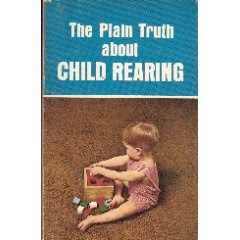
"Suffer the little children to come unto me," said the Stranger from Galilee - or the King James version thereof - and suffer they did. Church kids had a hard row to hoe with pressure on parents to keep their children in submission. Corporal punishment in the form of a solid whack was hardly unknown, and for some spanking was an art form. Garner Ted Armstrong's booklet "The Plain Truth About Child Rearing" set the tone, and the tone wasn't pretty.

Starting this weekend you'll find the first in a guest series on child discipline and the Bible by Samuel Martin on this blog. Samuel is the son of the late Ernest Martin, a major figure in WCG history who left in the mid-70s. He continued to exert a huge influence through his Foundation for Biblical Research and a variety of publications. Somewhere I still have a copy of his booklet that soundly debunks tithing.

Samuel Martin is author of Thy Rod and Thy Staff They Comfort Me: Christians and the Spanking Controversy. It would be interesting to get feedback and anecdotes from people who grew up in the church as the series progresses.

Sunday, 15 July 2007

Apocatastasis


Back in the Seventies and Eighties there was a good deal of speculation in the WCG diaspora about “universal reconciliation.” My memory is hazy, but some prominence was given at the time to publications from Concordant Publishing Concern, a non-COG ministry that, apart from producing an unreadable literal translation of the New Testament, championed a conservative Protestant view of universal salvation. Someone may remember whether this was a particular interest of Ernest Martin's... it was a long time ago.

These days the diaspora has ballooned out to tens of thousands, and the interest on unitarian-universalist matters has shifted to the unitarian end with Ken Westby and others pushing a “One God” teaching. The universalist strand remains however, even if it has gathered dust for a while. Back in the pre-reformation WCG a version of universalism was popular, based on the idea of three resurrections (Wayne Cole, for example, expressed the view that the number of those who would eventually wind up in the Lake of Fire would be the merest handful.) Many members found this one of the most attractive elements in Armstrong theology. The genocidal Calvinist god, like “predestination”, is a monster concocted from well down the reptilian brain-stem. Calvin, however, was simply standing on the shoulders of one of the truly dark influences in the history of Christendom, Augustine of Hippo, author of the Confessions and the man who put the book of Revelation in the Western canon, laid the groundwork for persecution of heretics, invented the “just war” theory, and cooked up the dismal dogma of predestination in his spare time. The Protestant tradition owes much to Augustine (Luther started out as an Augustinian monk), which may explain why apocatastasis now seems a novel idea. Augustine was also a relentless self-promoter and personal myth-maker, which has long protected his reputation (the biography by James O'Donnell goes a long way to correcting this.)

So I feel a bit of an idiot to have only recently stumbled over this thing called apocatastasis, courtesy of a reference by - of all people - Bob Thiel. This is an admittedly obscure term, but it describes a view, or speculation, that is perfectly acceptable both in Roman Catholicism (despite Augustine) and the Eastern Orthodox churches. In simple terms it means universal salvation.

Some of the great luminaries of early Christianity taught that all people would ultimately be saved: notably Origen (who took the position that even Satan would ultimately be reconciled to God) and Gregory of Nyssa. That much I already knew, but assumed it had been declared heretical long ago. Not so; and I was completely ignorant of the fact that one of the most significant Catholic theologians of modern times, Hans Urs von Balthasar, also advocates a version of universalism. While apocatastasis is not a sanctioned teaching, neither is it a heresy in the Catholic and Orthodox communities.

So Herb Armstrong wasn't all that unique after all. Mike Feazell – who seems to lean toward a similar reconciliation position – isn't a heretic.

As they say, “live and learn.”

Saturday, 14 July 2007

Inspired Forgeries?


Imitation is the sincerest form of flattery, but did imitation take a step too far into outright fraud and forgery in the New Testament?

There certainly were forgers out there. Two documents claiming to come from the Apostle Paul are obvious examples: Third Corinthians and an alleged exchange of letters between Paul and the philosopher Seneca.

These guys could be tricky. A text emerged in the fourth century claiming to be written by the original apostles. Called the Apostolic Constitutions, it brazenly advises its readers to avoid reading books that make false claims to apostolic authorship. Talk about chutzpah!

But what about the documents that made the final cut for the New Testament? There are at least six books claiming to be written by Paul that display the tell-tale marks of being pseudonymous (a scholarly way of saying forgeries.) The suspect letters fall into two groups: the Deutero-Pauline epistles (2 Thessalonians, Colossians and Ephesians), and the Pastorals (1 Timothy, 2 Timothy and Titus.)

That means, of the 13 letters attributed to Paul, nearly half are thought to be fabrications. That just leaves us with Romans, Galatians, 1 Corinthians, 2 Corinthians, Philippians, Philemon and 1 Thessalonians as genuine.

What about Hebrews? It's not by Paul either, but then it doesn't claim to be. Although it was included in the canon on the false assumption that Paul wrote it, it can't be considered a forgery as it makes no pretense to be from Paul (or any other apostle). Church father Origen wrote about the identity of the author: "God only knows." James was a common name at the time, and the letter bearing that name nowhere claims to be by the brother of Jesus; hence not pseudonymous. Revelation is in a similar category: John the apostle? Not likely. The Gospel of John is famously unconcerned with the end of the age, quite unlike the Apocalypse. While it's true that these books made it into the canon largely on wishful thinking about authorship, there's nothing in the way of such extravagent claims within these documents.

But there certainly do seem to be flagrant forgeries in the Pauline corpus. Unfortunately there's more. Chalk up 2 Peter as pseudonymous, along with Jude. Questions need to be asked about 1 Peter as well. The letters of John are also dubious affairs, most scholars optimistically attributing them to a later disciple of John.

Despite the special pleading of latter-day apologists, "forgery was almost universally condemned by ancient authors." The exception was in schools of philosophy where it was considered a bit of an art form to place your thoughts in the mouth of a great teacher of the past.

Bart Ehrman comments: "Many scholars are loath to talk about New Testament "forgeries" because the term seems so loaded and suggestive of ill intent. But... [it] is striking that few scholars object to using the word "forgery" for books, even Christian books, that occur outside the New Testament."

The beginning of wisdom in tackling the scriptures, whether the Old Testament or the New, is honesty. These ancient books are many things, but inflating their value by misrepresentation can serve no useful purpose.

Friday, 13 July 2007

8 Tribes


This is especially for the Kiwi readers of this blog - all 3 of you ;-)

Which tribe do you belong to? No, that doesn't mean Ngai Tahu or Tuhoe. We're talking North Shore (achievers), Grey Lynn (intellectuals), Balclutha (staunch rural), Remuera (entitled), Otara (community), Raglan (free spirits), Papatoetoe (unpretentious) and Cuba Street (avant-garde).

Harry Potter needed a sorting hat, but all you need do is answer a few searching questions with a modicum of honesty.

My results indicate that I should never try to cross the Auckland Harbour Bridge again!

Wednesday, 11 July 2007

Ekklesia and Linux Theology


Bill Ferguson points out that his Ekklesia site is still online, though inactive. BUT...

"Quango.net is about to be completely revamped with an Ambassador Report WIKI, a web board with RSS feeds and chat site. "
Good news. Check out what's available right now at www.quango.net. The pseudonym Qua Ngo shouldn't put you off! Among the site's drawcards are the writings of Bob Brinsmead, an ex-Adventist who put the proverbial cat among the Sabbatarian pigeons twenty five years ago. Try accessing the 1981 essay Sabbatarianism Re-examined. If you find that stimulating, Jesus and the Sabbath will be helpful too. I've yet to meet any Sabbath observer who can adequately deal to Brinsmead's arguments.

From Brinsmead to Don Cupitt, the British radical theologian who wrote the passage in the last post: one further quote.

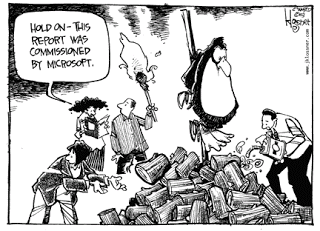
"[There is] a distinction between 'Microsoft theology' and 'Linux theology'. In Microsoft theology the operating system - the set of beliefs and practices - that you live by and work with is 'proprietary': that is, it is tied to a particular institution and its power structure. Somebody owns the rights, and demands his or her cut from you. But the newer Linux theology is 'open source' ... Nobody has been granted the franchise for it."
It's an interesting metaphor.

Tuesday, 10 July 2007

Changing of the guard?

Stan Gardner is another talented blogger who richly deserves a mention and a link. His blog is called Ambassador Reports, and I'm not sure why I hadn't much noticed it before. Stan has some fascinating material, including data on PTM finances. Another must-have URL for your favorites list.

Every few years there's a changeover in what's available in the ex-WCG online world. In ancient times (i.e. more than 7 years ago) the shakers and movers were Mark Tabladillo's site (inactive), Bill Ferguson's Ekklesia (gone) and The Painful Truth (which is still with us.) In recent history there was (ahem) the late AW site, a rambling love-it-or-hate-it affair (I started off loving it but ended up hating it.) These days the center of gravity is changing yet again, and I notice that Gary Scott of XCG and the Most Reverend "Kscribe" are both making noises about winding their sites back. Stan, "J", Felix and others are going to be busy.

Recently I was encouraged to put the old AW (passed away December 2005) back online in archive form, hosted in the US. I thought about it for a day or so, and even got as far as copying the files onto a CD and slipping it in a mailing envelope before sanity reasserted itself. The site would need extensive editing, and, well, there are other fish to fry at the moment. Some material may start to reappear - selectively - later in the year, but then again, maybe not. I find it hard to even look at some of that stuff now, like re-reading those ghastly yellowed school reports your mother turns over to you on your eighteenth birthday: "could try harder."

Unrelated: here's a quote that struck me between the eyes today. Next time I'll provide the source and some comments, but for the moment, considering "the Church" here refers to Christianity in general, what do you think? Agree or disagree?

"... the Church is not and perhaps never was chiefly for people who have a deep and serious intellectual interest in religion. On the contrary, the Church is for people who want to keep up comfortable old habits and associations, who want a feeling of reassurance and self-righteousness, and are happy to live by a ready-made Truth. They are content to go on slumbering peacefully. They want to be delivered from the extreme terrors and joys of real religious thought, and nothing is so effective a protection against religious terrors as conforming church membership."

Monday, 9 July 2007

Something Wiki This Way Comes


Russell Miller and the "J Source" have teamed up, and the Herbolatrous remnant should be quaking in their boots: it's a team to compare with the Two Witnesses.

Okay, so that may be taking poetic license a step too far, but this latest project by two talented and articulate ex-members documenting the Armstrong enterprise shows great promise. You can read about it here. Russell is a man of forthright opinions (he contributed several items to the old AW), and "J" (whoever he or she might be) operates a blog that has my nomination for best new COG commentary site.

We all have a stake in making sure that the facts don't conveniently go away, and this Wiki project may play a big part in that. One thing is for sure, Stephen Flurry and his ilk can't be allowed to get a free ride in whitewashing the history of the WCG.

Saturday, 7 July 2007

Give generously


The Good Lord takes care of His own, and He's certainly taking care of Greg Albrecht.

Brother Greg is being blessed to the tune of $160,000 clams every year. Hallelujah!

That information comes from The Journal online, you can check out the details yourself.

I have no idea how that stacks up against the average ministerial salary in the US. How much does your average Seventh-day Adventist pastor get for example? Or what about a mainline minister with a degree (a real one)? You know, the sort of minister who visits the sick, volunteers on community committees, supports the parishoners in time of need. Does Greg do any of that stuff?

Y'know, it must take a lot of donations from little old ladies to cover Greg's generous stipend. The kind of people who give to ministries like Greg's aren't usually among the wealthy. For every dollar sent to PTM how many cents go straight into his paycheck? And that's before we factor in Monte Wolverton's $98,000.

These seem to be 2005 figures. You've got to wonder how much of an increase the lads have garnered since then. Not that I begrudge Monte his 98k, all artists - and especially cartoonists - deserve to be paid so well. Dear old Ron Dart only gets 92k: truly a paragon of self-control (and remember, he has his NRA subscription to keep up!)

We're not privileged to know how much Rod Meredith pays himself, let alone Gerry Flurry or Big Dave Pack, but I'm guessing it's over the existing Albrecht high-water mark in each case. Such talented servants of the Lord indubitably deserve a double portion, don't you think? Dig deep brethren, the Lord loves a cheerful giver.

Thursday, 5 July 2007

Same old Spanky


From Roderick C. Meredith to his client sheep:

Many of our ministers and leading brethren have sensed a spiritual "malaise" coming over quite a number of our brethren. Since nothing shocking seems to be happening on the surface—though much is happening just underneath the surface in world affairs!—some are letting down spiritually! Fervent prayer and real Bible study are lacking. And no doubt partly because of this, some brethren are losing their spiritual focus and are beginning to feel that God is "far off," that nothing much is happening in world affairs and that it is not really important that we are all truly committed to being part of the Work which Christ is using us to do.
Translation: Income is down.

They don't realize that we are being used in a unique manner to truly "warn" our peoples of the Great Tribulation and also to genuinely "feed" God's people with the "whole counsel of God" (Acts 20:27). Many "little groups"—here and there—have part of the Truth and are doing a "little" part of the Work. But where is Christ primarily working and where are His eyes focused today on the Church He is using to prepare for the coming Kingdom of God? Most of you understand.
Translation: Members are slipping away to competing tithe-croppers.
But some of our people are confused and weak, and some are also discouraged that several of our brethren are becoming seriously ill with various forms of cancer, heart disease, etc.
Translation: I'm not feeling all that well myself.

So our Headquarters team unanimously agreed that we should call a Church-wide fast for the Sabbath of August the 4th!
Translation: All my Yes Men nodded when I told them.


Read the whole thing here - minus the helpful but speculative attempt at translation - if you dare.

Poor old Rod. Every time something goes wrong, guess whose fault it is? Yes, you brethren have been getting Laodicean! Notice that the Grand High Poobah doesn't include himself in the backsliding. My question would be whether the saintly Presiding Evangelist will himself be fasting on the 4th. Obviously he doesn't seem to think he needs to, and longtime observers will remember Herbert Armstrong's reputation for drinking coffee on the Day of Atonement, which he shrugged off with a "well, I always said there was no nutritional value in cup of coffee!"

July 4th is Independence Day in the US (have a good one y'all!); maybe August 4th should be Spiritual Independence Day for those of us with a background in Armstrongism, a day to feast heartily in celebration of the freedom from abuse members of Meredith's sect have yet to embrace.