
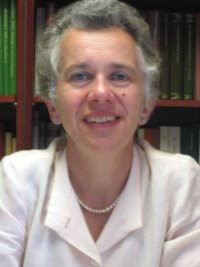
 Last night I attended a lecture by Judith Lieu, a professor of "divinity" at Cambridge University. I wasn't sure what to expect, but the promotional blurb from Auckland University looked interesting.
In the century and a half after his death the apostle Paul was remembered in many different ways, as Apostle to the Gentiles, intrepid traveller, pastor, persecutor and preacher. Christians claimed his memory and his authority to address the questions that troubled them; the Paul of whom they wrote may be very different from the Paul of later Christian preaching and theology but he offers us a glimpse into a period when Christians were having to find their place in the world.
It turned out to be an engaging presentation. Lieu placed the apostle in a second century context - as he was remembered by a subsequent generation - and drew on a wide variety of both biblical and extra-biblical sources. With her impeccably English accent, Lieu demonstrated just how little we really know about this seminal figure in Christian history, and the contradictory information that survives. These contradictions exist even in the canonical documents, and raise questions many theologians prefer to sweep under the carpet. Why does Acts, for example, not refer to Paul's letters? Why were his writings ignored for decades before being rehabilitated?
A key figure in the story of Paul's rise to preeminence is the remarkable Marcion, a "heretic" who almost became Pope, and drew together the first canon of the New Testament. Marcion is one of the forgotten figures of Christian history, but it doesn't take a lot of imagination to see his fingerprints all over the "genuine" Pauline epistles. That's a view taken by outspoken skeptical scholar Robert Price, and while Judith Lieu was far more judicious in her choice of words, I could imagine Bob nodding enthusiastically and making approving grunts.
The second century casts a long retrospective shadow on the first. All may not be as it seems. To hear that from a scholar of the stature of Judith Lieu was riveting.