Monday, 4 January 2010

From the original AW: "Hic"bert W Armstrong

A short item from oAW... includes some interesting quotes about Herb and his booze addiction.

The Worldwide Church of God during the Armstrong years had an extremely permissive attitude toward alcohol quite out of place among other Adventist sects. There was no precedent for this in the Church of God (Seventh Day), the group from which Herbert Armstrong split in the 1930's. Yet conspicuous consumption of alcohol was a definite feature of the WCG's Feast of Tabernacles celebration. Those who preferred not to imbibe were regarded as "weak in faith". The sad reality was, however, that many of the WCG's leading ministers had alcohol problems. Herbert W. Armstrong was no exception.
Holly Ruiz, wife of Enrique Ruiz, the church's office manager in Mexico, made this statement about HWA when asked by Mary Jones of Ambassador Report whether she'd ever seen him drunk:
I've never seen Herbert Armstrong sober after 8:00 at night. I used to notice this when I stayed in his home during conferences and on trips. He would fall asleep in his chair, and (Stanley) Rader would have to take him to bed. His daughter (Beverly) once told me never to call Herbert after 8:00 because he was always in a stupor by then.
John Tuit, writing in 1981, quoted Herbert Armstrong's grandson Mark:
"His liver is pretty bad, you know. He's got whatever it is you get from drinking too much wine and cognac. Boy, that's a real problem with him. He tells the Church people to drink in moderation, and for years he's been getting himself smashed just about every night... I've even helped carry him to his bed when he was just plain wiped out from too much booze."
Al Carrozzo, a minister who left in 1974, quoted Garner Ted Armstrong: "They have to pour my dad into bed every night." He stated: "I have seen him drunk on many occasions" (William Hinson. Broadway to Armageddon, p. 96). David Robinson, writing in 1980, told of Armstrong's slurred speech over a bottle of fortified wine (Herbert Armstrong's Tangled Web, p. 76). Armstrong himself admitted to excessive drinking as a young man, but "not at all even the fraction of the volume of an alcoholic" (Autobiography, p. 240, 1967 edition).
In Tangled Web, Robinson relates how HWA pressured him to name "liberal ministers" so he could fire them. By this stage of the conversation the "Apostle" had begun to slur his speech slightly because of the Harvey's Bristol Cream Sherry. "To name names in this context over a bottle of wine", wrote Robinson with a droll sense of humor, "seemed at the time to be injudicious" (pp. 75-76). He remained tight lipped.
Robinson commented on HWA later in his book: "Solace and sleep, such as it was, had to be induced by drinking much wine."

Sunday, 3 January 2010

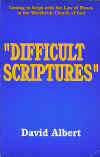
From the original AW: "Difficult Scriptures" reviewed

It isn't quite on the same scale as recovering the Great Library of Alexandria, but just before Christmas I stumbled on the long lost flash drive that held the original AW (oAW) archives. Now they're backed up on the desk-top computer, it may be timely to reinject a few bits and pieces back into cyberspace...

To begin with, here's a review that appeared on oAW of Dave Albert's book "Difficult Scriptures." It's a straight copy and paste, and hasn't been revised or updated.

A belated review of Difficult Scriptures: Coming to Grips with the Law of Moses in the Worldwide Church of God by David Albert, Tyler House, 1996
Dave Albert was best known to the public as one the presenters for The World Tomorrow in its last years. That such a high profile minister would come out in favor of the changes within the Worldwide Church of God must have been a huge asset for the church's leadership. That he would set his hand to writing a book about it was surely a much-needed gift for the beleaguered sect.
And yet, Albert's book seems to have quickly disappeared without trace. Published under a largely unknown imprint (Tyler House), it “did the rounds” for a time, going through at least three print runs, before sliding into oblivion. It didn't even rank a mention in Michael Feazell's later Liberation of the Worldwide Church of God.1 Today, the only way you're likely to get a copy is through a second-hand book service like Alibris.
Yet this book is the only one targeted at church members, the people most affected by the WCG's about face. Joe Tkach wrote Transformed by Truth for the larger evangelical market, and is seen by many as another part of the church's PR campaign to gain wider acceptance. Mike Feazell's Liberation also explains the church's journey (or, more accurately, the leadership's journey) to those on the outside. Albert however, took on the more difficult (and urgent) task of convincing those within the community he served. More than that, he was prepared to vigorously confront the proof texts and arguments that were being used to counter the new teachings.
Albert summarizes his case in three steps (p.188):
  1. The law of Moses is no longer required of Christians.
  2. The food laws and sacred day laws are part of the law of Moses.
  3. Therefore, the food and day laws are now matters of conscience and are no longer binding on Christians as matters of obligation.
WCG members will know that both the literature and sermons of the Armstrong era had a certain style and delivery which set them apart from most other Christian traditions. Even in a closely related sect or denomination (the Church of God (Seventh Day) or Seventh-day Adventists, for example) the difference was easily noticeable. Albert's strength is in knowing – and using – the familiar approach. In some ways the book is an extended sermon crafted to resonate with members.
How successful was David Albert? In doing research for this review2 I found that for a number of people it had been an important step in moving beyond the old teachings. In fact, several found it more helpful than anything the church itself produced. In contrast, one correspondent3 provided a copy of comments he had written that critiqued Albert's thesis from a pro-law perspective.
Albert's key thesis, that the Ten Commandments, Sabbaths and food regulations were an integral part of the Old Covenant, and that any distinction between the “spiritual law” and the “law of Moses” is illusory, is argued with relentless logic and passion. It is to the author's advantage that he already knows the likely objections, and his treatment of these is often devastating. It's hard to imagine anyone holding the assumptions most members have about the Bible, coming away from this book with any ideas about the timeless value of Old Testament observances unshaken.
Albert is at his best when addressing the weaknesses in Herbert Armstrong 's theology. Chapter 3 tackles the inconsistencies in the church's former position on clean and unclean foods, with Albert taking the reader through the article “Is All Animal Flesh Good for Food.” He is clear in his rejection of the old teaching:
Unfortunately, the logic used by Herbert Armstrong is without Biblical basis. He declared the food laws not part of the laws of Moses simply on his own authority. He then indicated that we ought to keep them because they're good for our bodies, and that's that! ... What begins not as spiritual sin, but merely as “physical sin,” proves in the end to be real sin after all because lusting after something wrong. (p.49)
It becomes obvious that Herbert Armstrong 's reasoning is not a sound Biblical treatment of the subject of the food laws. It wins support by inventing an extra-Biblical law, language, and logic. Worst of all, it contradicts the words and teachings of Jesus Christ. (p.50)
Does the book have weaknesses? I believe so. Albert seems, for example, unfamiliar with recent Biblical scholarship (though he does cite a few credible sources), and still holds firmly to a hierarchical paradigm.4 Chapter 15, an excursus into eschatology (why the Sabbaths seem to reappear during the Millennium) is particularly dodgy. None of these factors, however, detracts from the force of his overall presentation, which makes the failure of the WCG's leadership to use this resource to their best advantage stunning.
David Albert expresses his confidence in the way reforms are proceeding in the church (remembering that he wrote in 1996):
To its credit, the Worldwide Church of God has adopted the Biblical teaching and policy [referring to Romans 14:5] that no longer finds it warring with itself and others on matters of conscience. It is a policy that promotes peace and preserves unity, a policy we can live with.
Such rose-colored optimism seems a little unjustified in hindsight. He concludes with a plea to those who have left to “come home”.
May I say that I think your place is here – here in the same fellowship of which you have always been a part. Your place is is with us, your brethren, your spiritual family. We are not the same without you. Please come back to that part of the body into which you were called.
However, the most telling factor among those who have expressed a warm appreciation for David Albert's book to me is this: the overwhelming majority5, who were members at the time they first read those words, were, eight years later, no longer associated with WCG.
Perhaps he did a better job than he realized.
GR
Notes
1. Feazell also failed to mention Earl Williams. See the AW review of his book.
2. I asked for impressions on Mark Tabladillo's JLF group, and Douglas Becker's Missing Dimension group, as well as receiving further unsolicited comments from several readers who had seen the book review mentioned as a pending item on the Ambassador Watch website.
3. Available at http://www.webspawner.com/users/wmstorey/index.html
4. In chapter 6 Albert describes Peter as “pre-eminent church elder”, and is at pains to relegate James to a lower status, although it's unclear why he sees this as significant. The concept of the priesthood of all believers is notable by its absence from the book. He states “the living Christ has mandated change for the Worldwide Church of God” (p.187), but seems to have little concept of what the term mandate involves.
5. One gentleman, WCG elder Oleh Kubik, constitutes the main exception. Mr. Kubik's congregations, however, seem to have failed to "catch the vision". Once with more than 450 attending in two locations, the faithful have been reduced to a mere handful which meets once a month.

Accountability check


Friday, 1 January 2010

2009 - the year that was

January: Fred Coulter splashed out on full page magazine ads to promote his new Bible version. Weinland's "The End" website was drawing more traffic than any other COG contender, but the Obama inauguration demonstrated that yet another of his amazing prophecies had crashed and burned: "... there will not be a new president take office in January." Oops.

February: Publicity emerged about the forthcoming Wolverton Bible. John Morgan's Flying Free appeared in hard copy for the first time. Weinland was overtaken in web traffic by UCG's Good News.

March: News that LCG had spent megabucks on a flash new set for their TV show. AW scraped into the top half-million websites (as measured by Alexa). The Wolverton Bible was released to mixed cries of both hosanna and rhubarb by the ex-COG community. With flawless timing the Flurry cult (PCG) knicked some of Wolverton's artwork for their Trumpet magazine, while the local Distinctly Oklahoma rag provided Gerry Flurry with shamelessly facile publicity for his Ambassador Auditorium knock-off.

April: COG members observed Passover. AW linked to AC alumnus Jennifer Armstrong's intriguing travel book Dreaming In Arabic. Sheila Graham asked for submissions from Journal readers on women's experiences in WCG. Weinland's website dropped another place - behind both the GN and Flurry's Trumpet. Joe Tkach officially announced WCG's rebranding as Grace Communion International. James took over the helm at The Painful Truth, becoming the fifth editor. News that Gerry had been out shopping and returned with Big Sandy's bird sculpture to grace his cloned auditorium. Jonathan Meredith, son of Spanky, tried his hand at a spot of twittering, only to find that his unguarded comments were accessible to more than his mates.

May: News that the balance on UCG's Council of Elders may have shifted with the election of new board members. Weinland's website continues the slide... down to number 5 on the COG hit parade. Bill F. announces the closure of the Ekklesia site, while Norm Edwards resurrected Servants' News.

June: UCG's Paul Kieffer floated the idea of a cautious rapprochement with LCG. Gerry's Trumpet predicted Christ's return in less than a decade. Weinland appeared at IdeaCity in Toronto to smirks and chuckles.

July: Tkach announced that he had "tried and tried hard" to reconcile with disaffected members. Living University was authorised to issue worthless, non-accredited degrees. "Sientspirit" launched a series of short but powerful YouTube videos relating to her experiences growing up in WCG. Tom Mahon fulfilled a long-standing promise and uploaded a photo of himself to the Web. Willie Dankenbring raised his anti-Obama scripture-twisting to a new level of lunacy. Former Painful Truth editor John Bowers published a sci-fi novel. Dianne McDonnell had a hernia over Sheila Graham's article in The Journal. P.Z. Myers had a hernia over UCG's creationist ads appearing on his openly-atheistic science blog, and sent for a copy to review (which was, wouldn't you know it, never sent.) Pam Dewey made some pertinent observations on misogyny in the COGs. The first signs appeared of problems on UCG's COE with Richard Thompson leaving ("for personal reasons") and el Presidente Clyde Kilough making a discrete sideways shuffle.

August: The Living Armstrongism blog chalked up a remarkable success with an email campaign to put a spoke in PCG's efforts at distributing their rag via a South African firm. Weinland warned his devotees to stay away from social networking sites.

September: Willie Dankenbring discovered how to put his stuff up on YouTube. Australia's ABC noted the 40th anniversary of WCG co-worker Rohan's attempt to blow up the Al Aqsa mosque. Dave Pack appeared on a History Channel doco about Nostradamus. Greg Albrecht claimed he was reduced to eating beans in his efforts to preach the PTM gospel. Bob Thiel launched a book choc full of 2012 garbage. Carla Powers, a high-profile corporate lawyer with a WCG background, launched a book that dealt with her early years in the church, Matches in the Gas Tank. "Sideshow Bob" popped up again with the claim that he held a Th.D (Doctor of Theology degree) from "TCU," which later morphed to "TC of U" - an institution nobody could identify. Trumpet hack Ron Fraser had a rush of blood to the head and claimed that the Plain Truth magazine was "the most widely circulated of all periodic publications during the 20th century."

October: The 2009 FOT. More and more questions about Bob Thiel's so-called Th.D, culminating in some Internet research which suggests Bob picked it up by correspondence from a third-rate degree-mill in Kochi, India called Trinity School of Apologetics & Theology. No response from Bob.

November: LCG climbs on the 2012 bandwagon with a cover story (but no acknowledgement of their own in-house expert, Dr. Thiel.) Rumors of more internal strife on UCG's Council of Elders. Bob Thiel removes mention of the Th.D from his site, but indulges in rampant speculation about the new EU president's place in prophecy.

December: Paul Kieffer steps down - or maybe was pushed - from the COE after a long, bitter campaign by UCG's more gestapo-friendly elements. Weinland infers that he is the End Time Elijah - kind of. And finally, UCG's COE sends out an unprecedented appeal for unity to its ministry in the wake of ongoing trauma and the destabilizing activities of hard-line malcontents: 2010 could be a make or break year for the largest COG of them all.

And so to AW's 2009 awards.

For continuing chutzpah in the face of undeniable disconfirmation: Ronnie Weinland.

For services to amateur Biblical scholarship and translation, Fred Coulter.

For services to the Arts, with particular reference to collecting Herbal memorabilia and erecting monuments, Gerry Flurry.

For keeping up appearances, despite a guaranteed job for life handed down from his dear old dad, Joe "whataya mean a sinecure?" Tkach.

For promoting healthy food options, Greg Albrecht.

The AW "Watch this Space" award: the elected members of UCG's Council of Elders who have had to contend with vicious behaviour intended to destabilize their church and bring back "the colonels" who would, in turn, bring back on old-style, top-down regime.

Finally, AW's Person of the Year.

[Drum roll]

An individual who in 2009 has dueled with talk-show hosts and created video clips to promote his new book, suffered silently the slings and arrows of outrageous fortune when his eminent qualifications were churlishly questioned, tirelessly defended the reputation of ad-man turned Apostle Herb Armstrong, and loyally promoted LCG through thick and thin despite ingratitude... [insert fanfare!] the most remarkable "Th.D" the Churches of God have ever produced, ladies and gentlemen... Dr. Bob Thiel.

Rediscovering Xmas

A link to this article appeared on Purple Hymnal's blog on Wednesday, with the "get it while it's hot" hurry-up, as the Globe & Mail, a Canadian newspaper with a national circulation, only archives stories for a week. Thus, you should click across pronto, immediately, if not sooner. Here's the opening section.

I don't have traditional Christmas memories. No green and red lights strung through cedar boughs. No Christmas tree hung with silver bells and tinsel and ornaments. No carols, no Santa, no stockings, no presents, no choirs of angels. No angels of any kind.
Our family didn't celebrate Christmas.
My parents were part of an extreme sect of fundamentalist Christians who believed that celebrating Christmas was a perverse form of idolatry. For my brother and I, that made us different, odd, freakish. We weren't Jewish or Muslim. There was no acceptable reason for our celebration-less Christmases. It felt sinful to even ask and our parents offered no explanation. Ever.
In my Winnipeg childhood, my brother and I stood with our mother in the cold slush of Portage Avenue, enthralled as we gazed into the world behind the windows of Eaton's or the Bay. Apple-cheeked children glided over mirrored ponds, elves and reindeer cavorted in cottony white snow and the ubiquitous train circled the snowy village, tooting its little horn as it sailed past lamp-lit shops and tiny churches. It was a world that surely encompassed every child's Christmas dream.
Traditional COGophiles may scream "bah, humbug!" but it's a great bit of human interest journalism. Though the church is not identified by name, we're apparently talking pre-Tkach WCG.

Thursday, 31 December 2009

UCG letter, harbinger of a difficult year ahead

The following letter has been sent to elders in the United Church of God. While it's very long, it is reproduced here in its entirety.

Dec. 28, 2009

Dear Fellow Elders,

We would ask that you take this letter as a personal message of deepest spiritual concern. It is vital that each of you take time to read the entirety of its contents.

When the United Church of God began in 1995, we were all very humbled but guardedly optimistic about the future. We had the privilege and opportunity to carry on the legacy of preaching the gospel to the world and strengthening members within the Body of Christ.

It has been challenging as we strive to move forward in a form of church governance that has not been “the norm” for the Church of God community as a whole. But it was the approach, based upon biblical principles, that the General Conference of Elders ratified in 1995. At that time we were prompted to focus on the foundation of our organizational relationships and decision-making processes. Our collective attention became focused on the biblical principle spelled out in Proverbs 11:14, that “…in the multitude of counselors there is safety.” Most importantly, we made a collective decision that, rather than simply looking to a man, we would focus on Jesus Christ being the Head of the Church; and we were determined to sense the guidance of God’s Holy Spirit in us as our guide.

God has never left us or forsaken us even though at times we all have fallen short of His perfect guidance. As the Council of Elders of the United Church of God, we believe the Spirit of God is once again guiding and stirring us up to share certain basic words that must be said and understood by each of us. The time for decisive actions has come.

Over the past few months many accusations have been leveled against the leadership of the United Church of God. The Council, which is the senior governing body of the Church, has especially come under attack and been accused of lying, deceit, covering up and unethical behavior. While we are all only men, and have made our share of mistakes along the way, we reject such accusations as being without evidence, slanderous in some cases, and effectively harming the preaching of the gospel by diverting the focus of the duly elected board members of the Church. The time has come for straight talk from our hearts to yours, as brothers in Christ.

Rather than condemning and accusing what we see around us with our human perceptions, let’s consider where God places His focus. Ephesians 6:11-12 states that our real enemies are not one another but wicked or evil spirits in high places: “Put on the whole armor of God, that you may be able to stand against the wiles of the devil. For we do not wrestle against flesh and blood, but against principalities, against powers, against the rulers of the darkness of this age, against spiritual hosts of wickedness in the heavenly places.”

We are wrestling with an angry evil spirit that never rests in his focused attempt to destroy and scatter members of the Body of Christ. He tried to deliver a death blow in the 1990s, and now he is subtly striving to slowly but surely squeeze the life energy out of those who remain true to the gospel. We all realize that Satan knows he has but a short time left. Make no mistake about it: He hates, loathes and despises what we are called to stand for and perform by God’s grace, and this spiritual adversary will do anything and use anyone to frustrate our mission of preaching the gospel and preparing a people.

Much of our current situation goes back to 2007 through 2008 when a new makeup of membership began to emerge on the Council of Elders. A number of people have voiced the opinion that these men, all ministers with multiple decades of long-term service to the Church, could not have obtained a seat on the Council unless there had been “bloc voting” for nominees or candidates for the Council. (“Bloc voting” here means the formation of a group of individuals to support, promote or lobby for certain candidates for the Council in an effort to influence the ballot.) The suspected vehicle used to engineer such alleged bloc voting was an “alternate forum” (i.e., a private discussion group) comprised of a very small minority of members within the General Conference. Although no evidence of bloc voting has ever been produced for any candidate on any side of the issues, the opinion was expressed, and is still held by some elders today, that these are illegitimate Council members.

The Council’s position regarding private discussion groups involving elders is that they are not forbidden and violate no bylaw, resolution or scriptural principle. The Council has no oversight responsibility over such groups. Since they are private, unless there is proof that there is ministerial misconduct on such sites, it is not the Council’s (or the Church’s) responsibility. The Council will only act on substantiated reports of unchristian behavior by elders, whatever the context.

The detailed report on the alternate forum was officially approved by the Council as not only a statement regarding private forums (of which one or more likely exist at any given time), but was also created as a statement of what kind of fellowship we will be in respecting the rights of others while expecting the highest spiritual standard of all who hold the office of elder. The Council report included a statement from the forum’s administrator telling participants that it was not to be used for bloc voting or discussion of candidates, and the Council has since then received unequivocal statements from participants that it was not used for bloc voting. While some may not accept these statements or the conclusions of the Council in its report or its spiritual and philosophical thrust, the fact is that no actual evidence to the contrary has been forthcoming from anyone else.

The resolution to rescind the move to Texas was also passed in 2008 and created strong feelings on both sides of the debate that arose.

As a result of these differences and others, we have allowed Satan, as well as ourselves and our human nature that so easily besets us, to divide us into rigid camps. We have trouble accepting that others can have strong opinions contrary to our own and still have the best interests of the Church at heart. Satan has created an atmosphere of distrust. There has been a pattern now for some time of members of the same body demonizing (and we don’t use that term lightly) one another.

This spiritual malady of cancerous proportions has now seeped into our general membership with individuals (both within the ministry and membership) who now feel they have some mission to cleanse the Church and who have fallen prey to a spirit that desires to “reject authority, and speak evil of dignitaries” (Jude 8). They openly feel they have a godly duty to send out mass-circulated letters to undermine the Council of Elders and overturn determinations of the General Conference of Elders as to whom they chose to place on the Council. Knowingly or unknowingly, “confidential” or seditious information is being spread like wildfire. Such individuals have assumed a mantle of judge and jury in matters in which they have neither the full facts, nor the total context, nor the collective benefit of wide counsel. Rather, they have chosen to reject the sound principle found in Proverbs 18:17: “The first one to plead his cause seems right, until his neighbor comes and examines him.”

Can we learn to work together without vilifying one another? This is an ageless proposition that confronts every generation of the Church as to how we will relate with one another. The apostle Paul in Galatians 5:15 states, “But if you bite and devour one another, beware lest you be consumed by one another!” The New Century Version translates this verse as, “If you go on hurting each other and tearing each other apart, be careful, or you will completely destroy each other.”

Paul’s heartfelt concern and admonition is needed more than ever! The reputations of ministers who have served God and the Church faithfully for 30, 40 or 50 years are being undermined and destroyed—whisper by whisper, phone call by phone call, e-mail by e-mail, private meeting by private meeting by members and ministry. We seem free to “bite and devour one another” without talking to the parties involved, but based only on comments from others. Case in point: We have had ministers, called to be stewards of the gospel, who have posted messages on the Elder’s Forum, at one time or another that have lacked the basic Christian civility of knowing how to speak directly with grace or with full knowledge and context of matters on a forum designed to edify their fellow ministers.

Why do ministers who should know better sow discord? We have been granted the high calling of preparing and guiding others in spiritual preparation to be “kings and priests to our God” (Revelation 5:10). Why do some reject the clear admonition of Proverbs 6:16-19? “These six things the LORD hates, yes, seven are an abomination to Him,” we read. Then seven activities are listed that God hates. Verse 19 states that two of these are “a false witness who speaks lies, and one who sows discord among brethren.”

Due to this negative spiritual incursion into our fellowship, for more than two years we have been forced to focus our Church’s time, energy and resources inwardly, rather than focus outwardly to a dying world and the very real needs of God’s flock. When the Council states that it would like to see increased emphasis placed on preaching the gospel, an outward focus that has always been a driving force in the mission of the Church founded by Jesus Christ, the Council is accused of neglecting the local congregations, the youth in the Church or the responsibility of preparing the next generation of pastors.

While the Council strives to move forward with collective boldness and optimism, there has emerged a not-so-subtle negative spin or counter opinion on many actions of the Council. Allow us to speak plainly: This has been expressed in communications by some elders and members alike. Thus, the Church, notably in the United States, has not been allowed to move beyond the alternate forum, fears (not facts) about bloc voting, the rescind resolution and alleged ethical problems on the Council.

For example, the chairman of the Council has been unjustly and falsely accused of lying about the reasons for the replacement of the previous Council reporter and, then again, when a mistake made by the new Council reporter was not corrected before a particular report was distributed. Please understand, a Council reporter does not have a defined term of service. The replacement of our last reporter was based on financial savings and convenience as the new reporter is an employee at the home office (with long experience working with the Council as corporate secretary). Other supposed inappropriate reasons for doing so are simply not true.

The Council even gets criticized for conducting some meetings in “closed session,” a practice that is recommended by experts on nonprofit governance and which has been used by the Council since 1996 to discuss important issues of a private and confidential nature in a more candid manner. No law or bylaw bars this long-standing practice, but it is now being given a sinister spin.

These accusations against the leadership have taken on a life of their own and are spreading rapidly. Do we realize that this approach is destabilizing the ministry and beginning to destabilize the Church? We have a toxic atmosphere in the Church where innuendos (“it looks like...”) and whispers are creating an unrestrained chorus of misinformation put forth by minds and hearts lacking sound judgment. Some in the ministry appear to be getting together and “roasting” the Council based upon second- third- or fourth-hand hearsay or rumors. Some claim their “information” came from confidential executive session information that they feel they have the “right” to place in the public domain. Such “information” is biased, imputes evil motives and is often completely wrong and not designed to help or bring peace to the Church of God, but is spread by those who presume they are “in the know.” We constantly hear that information comes from a reliable source, but no one is willing to reveal that source. Is this because the source may have an agenda? Why are some willing to risk their all and the well-being of a Church dedicated to God’s service simply on anonymous accusations?

We would never have allowed this in our former association! We would never allow it in the congregations that we pastor. In what some of our members like to call the “real world” in which they work, such breaches of confidentiality, slander and lack of organizational cohesiveness would be dealt with immediately by appropriate disciplinary action for those responsible. Why should we be different and why should the unity once a hallmark of God’s people be different now?

Please consider these scriptures that focus on this topic.

Proverbs 26:20-21: “Where there is no wood, the fire goes out; and where there is no talebearer, strife ceases. As charcoal is to burning coals, and wood to fire, so is a contentious man to kindle strife.”

Proverbs 16:27: “An ungodly man digs up evil, and it is on his lips like a burning fire.”

What is the solution that has been suggested to the Council by more than one individual? For the Council to resign en masse and hold a new election for all Council seats! Such a solution is not even possible under our governing documents! The real solution is that, accompanied by much prayer and fasting, we all individually need to turn the mirror around and look at ourselves. As the book of James explains, “If anyone among you thinks he is religious, and does not bridle his tongue but deceives his own heart, this one’s religion is useless” (James 1:26).

Allow the following statement to be clear and understood by each of you who read it. This letter is designed and designated for the specific purpose of being a direct intervention action by the Council of Elders for the spiritual well-being and organizational stability of the United Church of God. In 1995 the United Church of God established a system of governance that gave the Council of Elders the responsibility to provide direction, oversight and guidance within the Church. Allow us to be blunt and to the point. The present atmosphere among some in the ministry, and now increasingly filtering into our general membership, is spiritually damaging. Such conditions impede our ability to spiritually and organizationally function. The situation is neither worthy of the high calling by God the Father nor the devotion of His Son, our Savior.

In 1995 the United Church of God established a system of governance that gave the Council the responsibility to provide oversight and guidance within the Church. In 1995, as a duly constituted General Conference of Elders, we all approved the following:

1) The General Conference of Elders would have the ultimate authority in the sense that it can select new Council members, approve amendments and responsibly guard the doctrinal integrity of the Church.

2) The Council of Elders would have authority as a collective body to govern the Church.

3) The administration headed by a president would carry out the daily operations of the Church, based on the directives and guidelines of the Council.

Apparently many do not understand or have forgotten or chosen to ignore this constitutional reality, but this is the binding agreement of our organizational form of governance. The Council is the primary governing body of United, and we all must learn to work together. How can we expect to be kings and priests if we cannot deliberately decide to walk and work together? Shouldn’t we expect the ministry of the Church to set an example of how to work together? Do we expect God to bless an organization in which even the leaders cannot walk together?

Many have said, as has the Council in public and private deliberations, that what separates us is not doctrine, but philosophical and administrational perspectives. We all validate the oneness expressed by Paul in Ephesians 4:4-6: “There is one body and one Spirit, just as you were called in one hope of your calling; one Lord, one faith, one baptism; one God and Father of all, who is above all, and through all, and in you all.” Beyond this, we all agree on the scriptural revelations regarding the Ten Commandments, God’s plan as revealed through the Holy Days, the approach of the literal Kingdom of God and so much more.

What divides us are not matters of biblical information and truth, but spiritual application of some of the most basic of Christian principles. Jesus Christ implored those who would follow Him to worship in “spirit and truth” (John 4:24). The reality is, even though we have been strong in the truth of what we know, we have been weak in those matters of “the spirit”—of who and what we are to be.

Yes, matters of “the spirit”—like going to your brother (Matthew 18:15-16), evaluating your own spiritual moorings before correcting another (Galatians 6:1-2), avoiding following people and saying “I am of” this man or that man (1 Corinthians 1:12-13), focusing on the positive (Philippians 4:8), leaving our worries with God in prayer and fasting (Philippians 4:6-8) and, yes, forgiveness! How can we effectively preach a message of repentance, forgiveness and reconciliation of our fellow human beings to our Heavenly Father if we cannot be reconciled ourselves? Such talk is cheap and falls on shallow ground if we do not show proof of Christ living in us.

The Council of Elders is concerned for the preservation of the United Church of God.

This is not simply another letter to merely encourage us to consider “getting along.” This is not only a new day, but a new way of moving forward. There is a collective need and responsibility for every officer of the Church, every level of management, every employee and every minister to support the direction and resolutions of the Council and the General Conference of Elders. Some of those resolutions you may not personally agree with, but they will have been arrived at within the governance structure that we have all accepted. All should support them in a manner consistent with Christian principles and communication, while at the same time exercising our privilege as individuals to contribute to the ongoing discussion concerning the welfare of the Church. Those matters that have been formally reviewed over an extended period of time and approved by the Council (for example, the Council’s conclusion that no evidence has been presented that “bloc voting” for candidates via an “alternate” discussion group occurred) will not be revisited unless new and extraordinary circumstances dictate otherwise. We must move on from here with those who desire to move forward.

The Council will rely upon all employees, elders and members to act upon this basis of assurance and Christian goodwill.

With this resolve established, are we saying that Church leadership should simply be followed and never questioned? Absolutely not! There are a number of responsible communication and governance mechanisms in place to assure a wide level of input. But once a decision is made, we need to move forward and quit rehashing the same issues, objections or opinions of detractors over and over again.

We fully understand that every Council, past, present and future, will not be perfect. The members of this Council have been diligent and merciful, knowing we have men with strong feelings on opposite sides of issues such as relocation. In attending to Council responsibilities, we accept that actions on issues of the past three years may have not been as well considered as they might have been. But they have been mistakes of procedure, not of the heart. Beyond that we eagerly look forward to working with a duly appointed administration that works and serves at the pleasure of the Council on behalf of the General Conference of Elders.

As an organization, United has so much going for it. We are on the cusp of so many dynamic dynamicopportunities. Our ways and means of preaching the gospel via the Internet, commercial television and publishing are just now crystallizing in a way that will hopefully merit God’s blessing and be used toward His glory. We are seriously looking at remodeling our home office facility in a way that will facilitate the needs for an expanded effort by a growing Church. Always behind this are the faithful members, trained and dedicated pastors, elders who go above and beyond the call of duty, skilled and experienced employees carrying out important functions, and numerous volunteers serving in our Church youth and educational programs. Yes, good things are happening that should allow us to move forward with great confidence that the work God has given us to do will be done well.

We have laid out where we have been, where we are, what we expect and where we are headed. It is our eager hope that you will desire to be a part of a unified effort based on these shared heartfelt words. We realize this letter will be received by different individuals in different ways. One individual might describe these words as long overdue, while at the same time another might be challenged by its implications. Please know that we are all being challenged at this time to move forward in a godly manner. It is our deepest desire that you will continue to support the efforts of the Council as it guides the United Church of God toward fulfilling God’s purposes.

As we move forward, we are going to advance by not only focusing on the word “united,” but focusing on a key attribute of the Head of the Church, Jesus Christ, who is the Prince of Peace (Isaiah 9:6) and whose Spirit brings us peace (John 14:27). Beyond that, “united” does not mean merely external conformity to rules, bylaws and policies. True unity comes from God’s Spirit working in us. It is your personal gift to God and to others that your life’s confession and its fruit by word of mouth and deed is “not my will, but Your will be done.”

With these stated goals in mind, we are encouraging the entire ministry to devote time during the month of January specifically for prayer and fasting in seeking God’s guidance and perfect will toward us as individuals and as a collective body of believers.

Dear friends and fellow servants of the Living God, we need to work together with a common purpose—not divided by our differences, but strengthened by our commitment to the far greater things that unite us.

In deep respect,
Council of Elders

Tuesday, 22 December 2009

AW on holiday

From today AW will be taking a much needed two week break from postings. You'll still be able to access the blog, but there will be no new content during this time, including comments. I will still be updating over on Otagosh, which has a broader focus, so feel free to check it out if you have withdrawal symptoms. Sometime over the next day or so there will be a review of a book I highly recommend - especially to (nudge, wink) Leonardo and the hard-core atheists among us.

When AW returns there'll be a special "year in review" feature, and I'll spell out my intentions on whether to continue with AW, and if so, what changes can be expected. What does that mean? Right at this very moment, I don't know myself, but a couple off weeks away from the salt mines will hopefully lend some clarity on that issue.

See you in 2010!

Monday, 21 December 2009

What if...

"COGers, Armstrongists, WCGracies, Papists, Defectives, Sinners and Loons.

What if..."

Guest commentary by Dennis Diehl

The purpose of most religion is to make us "better" than we currently are. The Biblical premise is that all human beings are fatally flawed, not good enough and in need of vast improvements and control of their "human nature." Without this ongoing overcoming of the evil self, growing towards a better kind of person and change, one runs the risk of being so not good enough that they will spend eternity, for their inability to change over a rather short lifetime, in a punishing hell. Scripture goes out of its way to remind us all that our fundamental human qualities are deceit, wickedness, jealousy, anger, lust and greed. I find that personally to be one of the most unhelpful and controlling lies ever foisted upon human beings by religion. Of course that is how we can act, but that is not who we are by any real means when given the freedom to be authentic and feel safe in being so.

We are called "worms" and less than nothing in this great book of encouragement. Even the early leaders, prophets and apostle-types knew that they had to degrade themselves as less than human in order to show they understood they were not worth anything as an unregenerate human being. Only when one realized they were a piece of poop, could they lead the people who were really poopy people. If you could not utter the words, "I am not worthy," you would never be a Bible CEO. The Apostle Paul noted that he was "the least of the Apostles" and that "the things that I don't want to do, I do and the things I should, I don't." He made his problems everyone's. He concluded he was simply a wretched human being, and so should everyone else. He reminded others that they were blind, miserable, poor and naked of heart and spirit. He even said he had to beat himself into submission, lest after preaching to others, he should flub up himself and be a castaway. Seems he didn't have the confidence "in the blood," to make up the differences in what he was and what he felt he needed to be.


Jesus is also said to have said that humans are to become "perfect, even (in the same way) as your Father in heaven is perfect. The word means "complete" not "perfect.' There is a huge difference. What if are complete already? What if we were born right the first time?


How did we get this way? Well, of course it was due to the "fall" where Adam and Eve, our really true and actual first human parents, created by God out of mud and ribs, flubbed up and ate the forbidden fruit. We can only take comfort in that the story finds it's origins in Sumerian Mythology.


We have all been blamed for this event and must spend our lives coming under a blood sacrifice of a more perfect human/god being and then continuing the struggle to be "better" until we die. It's then we find out if we understood being bad enough to be good enough to live forever. Redemption of humans by blood sacrifice and execution have always been the preferred solution to the depravity of man. Membership in the club usually cost ten or more percent of your material income and membership in the one true of many churches. I am not being disrespectful to the life and teachings of Jesus, but few understand how that has been woven into a tale that Jesus himself would have cringed at.

Have you ever considered the fact that you and I may have been born right the first time? What if the most simple and spiritual goal a human being has is to become your own genuine, authentic self? What if our purpose in life is neither to jump through the hoops set out by others, who think they know, nor to struggle and strive to improve yourself dramatically over what you are? People don't change much over a lifetime no matter what their religious affiliations, and while it's an improvement to stop killing one's self with sugar, caffeine, alcohol and nicotine along with other assorted body killing habits, it's ok to just be yourself.
Is it easy to be yourself? No, not in our culture and certainly not in many others where not being a mere cog in the tribal wheel can get you killed in really bad ways. One of life's simple truths that most humans have long since forgotten, or never knew, is that all of us are one and the same and all smaller parts of the one single thing. I don't pretend to know what that is, but let's just say we are all one in the same conscious awareness stuck in a limited five sensed carbon based wet suit for now. As Mike Adams said in a recent article on the discovery of DNA variability, holographic blueprints and the symphony of life... "We are, in fact, an expression of the very phenomena we are attempting to understand, and if we read the poetry of DNA correctly, we will realize that life itself is not about the accumulation of wealth, or stuff, or power over others, but rather the discovery of self. And "self" does not exist in isolation. We are, in every way imaginable, intertwined. We are all made of the same stuff, wrought from the same patterns of nature, and in fact, formulated from the same musical notes played out in five billion unique but compatible tunes. With this discovery, Western science has concluded we are all more different from each other than previously thought, but I believe it is evidence that we are all just unique verses of the same universal poem."
That's a far cry from humans being merely wretched, miserable, poor blind and naked worms that need major rehab at the hands of prophets, priests and pastors who are just as, if not more, flawed than the congregation or the nation. Saying we are born right the first time and not in need of being born again or reborn goes against the meme, which is the mind virus we all got taught as kids. Our parents had it taught to them and their parents before that. It is the idea that we are all flawed at birth by a non-event in the lives of our first not-literally-so parents Adam and Eve. It's the idea that even if you are a pretty ok person, you are filled with vanity, jealousy, lust and greed that, unless paid for by a perfect blood sacrifice, demands you spend eternity in hell burning forever, cut off from God, or permanently dead. It's also not true and is not what a genuine human being, in reality needs to become the monkey on their back over.

What liberation it is to simply recognize that we are all one and the same smaller parts of the one big thing. It is every bit as difficult to live an authentic life as it is to live a life of false compliance to the will of others. It is easy or not easy depending on the need to please everyone or appear to agree when you don't, to be true to your self - and by self, I do not mean ego. I mean true to the conscious awareness that abides in the container we all too often mistake for the self. You are not your body. That is merely transportation and a container for a short time. You are not your brain. That is a receiver of information and memories that may, in fact, arise from outside of a bigger you and I than we can imagine. You are not your mind, which is that thinking brain that spins in the angry past or projects itself into the anxiety filled future when it has nothing better to do in the present.


How much misery and struggle to be all that one can never really be religion has heaped upon the faithful. Not many will leave the warmth and comfort of the boxes they were born in by happenstance and explore ideas that are not acceptable to the tribe or the church. But some will. They might be labeled "heretics" or perhaps more benevolently, "ahead of their times." In the past, those ahead of their times tended to be burned at the stake. Leaving the box of religious dogma is difficult and often one leaves it alone and on their own. Those in the last box don't often follow. You can be your authentic self as it comes to you and risk a lot but gain a lot, or you can put on your mask and be more comfortable by scarfing down antidepressants the rest of your life. That seems to be the road to the fact that being oneself is the most simple spiritual truth there is for a genuine human being.


Don't label yourself as belonging to this or that group. Don't label others for belonging or believing or thinking or even not thinking. We are who we are. NOT ONE PERSON I EVER KNEW WHO TAKES THE TIME TO PARTICIPATE ON AW HAS UTTERED THE WORDS, "THANK YOU, I NEVER THOUGHT OF THAT AND I AM NO LONGER GOING TO BELIEVE WHAT I BELIEVE NOW OR BE WHO I NOW AM."
The joy and the challenge is in the journey not the ultimate find. Be yourself and consider that you might just have been born right the first time.

Sunday, 20 December 2009

Santa brings Ronnie a special present

Santa has been making a list and checking it twice. Has Ronnie been a good Witness? Well, of course! So Santa has a bright, shiny new present for the lucky lad. The news is beginning to circulate as the Xmas bells chime: Ronnie is the Elijah to come.

Well, wouldn't you know it. Silly me for not realizing it straight off.

So far there are no links to "official" Weinland pronouncements, but I daresay they'll follow.

Ron, if you're out there, congratulations! And while you're basking in the glow of your new prophetic status, you might like to consider your candidacy for several other biblical honors. You could be Melchizedek or even the Logos. I mean, why should that Jesus guy hog all the limelight?

Postscript. Details on Mike's blog, and an audio link - for the masochists among us - to the relevant sermon. Exactly what Ronnie is claiming is a bit hazy. On the one hand it seems he's not going to grab the goodies, but after beating around the bush long enough to keep the sheep dizzy he states: “I am the final fulfillment of the Elijah-to-come”.

Sure Ron.

A view from the pews

A powerful piece of writing on the changes that hit WCG in the early nineties appears on Purple Hymnal's blog. If you've wandered here from some other background, and wondered what all this fuss and discombobulation about a church is about, then read this. It's the view from the grass roots, and it explains an awful lot.