Monday, 2 July 2007

Mad Dogs and Englishmen...


Here I am complaining about a spot of winter drizzle while the British Isles have been receiving a pummeling from the weather gods. English weather has long been the subject of general hilarity in the rest of the world, but there's nothing even faintly funny about people losing their homes and even lives.

We all know what Spanky and Six-pack Gerry will say about such calamities: God is teaching the godless a well-deserved lesson. The Big Bloke in the Great Beyond has a short fuse, and every now and then the temperamental old sod lets fly with a hissy-fit. Flood, famine, tsunami, itchy boils... the god of Big Dave and the Herbal pretenders is anything but subtle.

Surprising then that a bishop in ye olde Church of England is prattling about the same thing. Under the previous Archbishop of Canterbury, reputed to be a hyper-conservative Evangelical, the bishoprics of the land were filled with card-carrying members of the so-called "evangelical" wing of the C of E., which is a large part of the reason the current archbishop, looking thoroughly frazzled, made the cover of Time a week or so back. Perhaps the former incumbent thought a theologically stiff upper lip might arrest the decline in attendance. If so, he was dead wrong.

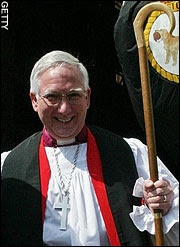
In any case "the Rt Rev Graham Dow, Bishop of Carlisle," (the frocked fellow in the photo) has entered the fray with a word of divine consolation for the sodden citizenry worthy of Monty Python, as reported by the Telegraph.

"This is a strong and definite judgment because the world has been arrogant in going its own way," he said. "We are reaping the consequences of our moral degradation, as well as the environmental damage that we have caused."

How Meredithesque!

"We are in serious moral trouble because every type of lifestyle is now regarded as legitimate," he said.

"In the Bible, institutional power is referred to as 'the beast', which sets itself up to control people and their morals. Our government has been playing the role of God in saying that people are free to act as they want," he said, adding that the introduction of recent pro-gay laws highlighted its determination to undermine marriage.

"The sexual orientation regulations [which give greater rights to gays] are part of a general scene of permissiveness. We are in a situation where we are liable for God's judgment, which is intended to call us to repentance."


The Telegraph reporter notes that the bishop is "a leading evangelical." Well, whatayaknow! Dow even goes on to compare the wicked world of today to the Roman Empire: "people should heed the stories of the Bible, which described the downfall of the Roman empire as a result of its immorality."

Well, shucks, where did I put that Ambassador College booklet The Modern Romans?

But here's my constructive suggestion. If the troglodyte bishops of Britain are going to steal COGdoms finest ideas, it's only fair if Rod, Gerry, Dave and the boys steal the Anglican regalia. Can't you just see Rod in a dress holding his staff with manly firmness? Or Gerry with a Roman collar and silly hat?

We might have to modify those religious titles though, "Right Reverend" just won't cut it in our tradition. How about "Right Rabid" instead?

Sunday, 1 July 2007

Winter's blast


Alright, so you Northern Hemisphere types can smile, but in the great Down Under it's winter, the days are short and the audible pitter-patter of rain is persisting on the roof as I sit here at my tidy desk - despite having Beethoven's Choral Symphony turned up several notches above normal. Well, I mean, what else is there to do on a Sunday like today other than wander around looking for jobs to do indoors while listening to music?

And might I add that the news out of Valencia isn't helping things either. Half a world away New Zealand is engaging the Swiss in the Americas Cup. Staying awake till ungodly hours to watch the coverage is demanding enough, but those balmy Spanish temperatures and sunshine are cruel and unusual punishment at 2AM. To rub salt into the wound, the Swiss - or rather the rebel Kiwi sailors who went over to the Swiss - are doing far better than they deserve. By the time this goes online it may be all over, but for the moment the quislings still have to win one more.

Biased? Who, me?

Then, the cruelest blow of all, the All Blacks went down to Australia last night. Do I need to explain that the ABs are the national Rugby team, that Rugby is the national game, and that Australia is the ancient foe?

The yachting provides an analogy for this blog: which is just as well seeing it isn't providing much good news otherwise. Since AW reappeared in this form a bit over a year ago, both it and I have been "tacking away" from a tight WCG/splinter focus to something a bit broader. The current "series" of the long-running COG "soap" is, after all, but a pale imitation of seasons past.

Today's highlight (apart from the pleasure of discovering a desktop under piles of paper and coffee mugs) was getting notification of passes in the two theology papers I took last semester. No rest for the wicked, however, and tomorrow night the first audio-conference is scheduled for semester two's Dead Sea Scrolls paper. Among the set readings is one from someone called James Tabor titled "Patterns of the End: Textual Weavings from Qumran to Waco." I just bet it'll be heavier going than his blog entries...

On an unrelated note, New Zealand WCG member Dennis Gordon has an excellent article on Genesis and Creation in the latest issue of WCG's Odyssey magazine, well worth checking out!

Monday, 25 June 2007

Spit or Whistle?

Yes, if those thinning pates and grey hairs of wisdom are any indication, the COG demographic is sliding inexorably toward elder-status, and in this case elder comes without ordination credentials. In a generation the numbers will be heading on the downhill slide past the point of no return. Indeed, I think I saw the milestone a few kilometres back... but maybe it was a millstone instead. The brash, vital, growing Worldwide Church of God of yester-year only lives on in our memories and nightmares.

But wait, misery loves company, and its comforting to know that COGism is far from alone. Across The Ditch in the fabled land of Oz, the mainline Australian denominations (Catholic, Anglican and Protestant) have been involved in something called the 2006 National Church Life Survey (NCLS). It's full of the usual pacifying pabulum, such as:

There has been a dramatic increase in the proportion of attenders who are aware of their church's vision, goals and directions.

Uh huh... very inspiring if fuzzy around the edges. But before breaking out the grape juice and marinated tofu, consider this Ocker shocker:

A matter of concern is that the average age of church members is going up. It is now...

Take a guess. The average Aussie church goer is, what, in their late forties maybe?

... 53 years.

I nearly let out a whoop. I'm still a youngster! Well, only barely, but I'll take whatever slack I can get!

Mind you, that's Australia, and my guess is that the Kiwi average age is higher. The USA seems, as always, a little different, but in the rest of the English speaking world Christianity is in deep trouble, and it's probably the author of its own misfortunes. I'm mean, take the Anglicans ... please, someone, anyone!

Religions pass their use-by date, and WCG's was probably 1975. On the macro scale Christianity itself has a problem, and circling the wagons fundamentalist-style is a bit like spitting in the wind.

Meanwhile, the mainline churches are - if not spitting - bravely whistling in the dark.

National director of NCLS Research Keith Castle writes, 'Perhaps the church in Australia is moving beyond the sense of despair that has permeated its life (particularly in the mainstream churches) for possibly two decades. I see glimpses of a new determination to present the gospel of Jesus Christ in creative and relevant ways in this complex society in which we live.'

Translation: I'm fresh out of ideas; is it time to panic?


NCLS Research: weblink
Quotes from Brian Schwarz, "Vital Signs", The Lutheran, June 2007.

Sunday, 24 June 2007

Jesus, Paul and Sex


Have a gander at James Tabor's latest blog entry, where he launches out into a feisty discussion of dualism, sex and the New Testament. To say the least, interesting questions are raised. Enough here, one might fear, to bring on an angina attack for some good folk who feel more anxious than adventurous when it comes to religious security. Those of us who appreciate the spill, splatter and swish of blood from sacred bovines, however, may well let out a hearty cheer.

And to think that James used to fill in by taking classes for "Doc" Meredith when the "leading evangelist" was away from Pasadena...

Saturday, 23 June 2007

Rated PG


Alas, AW has been rated PG. The only consolation is that my favorite bete noire, Doc Thiel, has received the same rating. Children (in the unlikely event that any actually read this blog) should leave now, unless accompanied by a responsible adult (which probably excludes any of you who belong to PCG.)

The squeaky clean Gary Scott, despite calling his excellent blog XCG, snatches a G rating, as does Felix Taylor. Excuse me while I go sob in a corner...

In any event, for those few readers who don't already realise it, the main Thiel newspage has been bloggered. Good move Dr. Bob. You'll always learn something new there, such as the astounding fact that ye olde Rise and Fall historian Edward Gibbon (not Gibbons, sorry Bob) wasn't a COG member, gasp! Now I ask you, where else would you find an assurance to that effect?

Friday, 22 June 2007

The Plain Truth and the Judas Gospel

April DeConick is a professor of Biblical Studies at Rice University and a mighty fine blogger as well. In a recent entry she mentions a certain magazine:

Professor Tim Finlay (Azusa Pacific University) has just published a brief but detailed article on the Gospel of Judas in The Plain Truth. Most of his analysis is fairly accurate... but I have to dissent on his conclusion that the Gospel of Judas "confirms that Irenaeus and the early Church were right in what they said about the non-canonical Gospels. Matthew, Mark, Luke and John remain peerless from both theological and historical perspectives."

Why do these conclusions continue to be drawn by biblical scholars, as if the canonical gospels are any more accurate (or "peerless") theologies and histories than the non-canonical gospels? All these texts are theologies, and whether or not they are "peerless" depends upon where you are standing. None of our texts are histories, let alone accurate histories. And how much historical information we can actually reap out of any of them, and the procedures for doing so, are questions more problematic than not.

As for the accuracy of the Church Fathers' descriptions... [they] passed on false information, ill-informed interpretations, and fabricated stories in their struggle against those forms of Christianity that they hated. As the old saying goes, "All is fair in love and war."


Straight talk: gotta love it!

Finlay is a former AC graduate. While on the subject of women scholars (last time Amy-Jill Levine, today April DeConick), this coming Thursday I'm planning on attending a lecture by American Lutheran theologian (ELCA) Kathryn Tanner. Tanner's interests fall outside my reading and study experience thus far (Christianity and economics) but it should be a stimulating presentation. Remember the days (if you're old enough!) when a woman's by-line was not permitted in the Plain Truth or Good News? Now the intellectual strength of women writers and scholars is commonplace - and even the dowdy old WCG has ordained women elders.

I, for one, am enormously grateful for the winds of change.

Monday, 18 June 2007

Amy-Jill Levine


Tonight I attended a public lecture at Auckland University given by New Testament scholar Amy-Jill Levine, currently on a tour Down Under. Levine is a joy to listen to, and a highly distinctive voice in the field (and I don't just mean the New York accent!)

For a start, she is a member of an Orthodox Jewish synagogue. Most New Testament scholars are of course professing Christians, but invariably exude a dour Calvinism, a mixture of apologetics and thin-lipped worldly denial. Jewish teachers don't seem to have that problem. While Catholics and Protestants tend to wallow in the awful sinfulness of it all, the Jewish view is generally far more optimistic, mercifully lacking the concept of original sin. I swear that you could tell the Presbyterians in the audience: they were the ones who didn't get the humor!

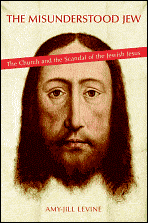
In the fundagelical camp there are those (usually devotees of the arcane discipline of "systematic theology") who suffer under the illusion that only Christians (i.e. their kind of Christian) can have anything relevant to contribute to theological discussion. Levine gives the lie to that myth. The church was conceived within first-century Judaism, inspired by a Jewish prophet, spread abroad by a Jewish apostle. Levine, who works tirelessly to emphasise the essential Jewishness of Jesus and his message, asks the kind of questions that bring us closer to the "real Jesus" than most Christian scholars are capable of. Being outside the fold, so to speak, means she can afford to be honest and direct. The denominational hacks who dominate the field could learn a lot from people like Levine. Her recent book The Misunderstood Jew is not to be missed. It's a sensitive, respectful look at Jesus through Jewish eyes, minus the Christian schmaltz, which makes it a uniquely valuable contribution.

Tuesday, 12 June 2007

Just what do you mean - Affiliated?


Bob Thiel is shocked, shocked!

Brian Knowles once wrote for the Plain Truth. But now is affiliated with ACD, a unitarian group. It is shocking, to me at least, that CG7 would include an article in one of its publications from one who apparently does not believe that Jesus is God.
Leaping to conclusions is the exercise form of choice for many old-time COGgers, and this seems a perfect example of the sport.

(1) Brian once wrote for the PT. Very true. In fact, he was the editor as I recall it, and one of the best that publication ever had.

(2) But now he's "affiliated" with ACD. Well, he writes commentaries at Ken Westby's invitation, and contributes to their blog. If that's what "affiliated" means, I guess that's true. Does he receive a salary from Ken? I very much doubt it. I assume Brian knows Ken from way back, and it's highly doubtful Brian had to sign a unitarian article of faith before his material was cleared. Brian wrote for The Journal too (basically the same articles that appeared on ACD), does that make him "affiliated" there as well? But, shock, horror! Bob has also written for The Journal, does that mean Bob is "affiliated"? I can sense the need for Bob to write a new, very long and ungrammatical article of explanation for his website: Just what do you mean... Affiliated?
(3) ACD is a unitarian group. I have no idea if ACD has a board, or who else is involved in running the group, or even if it is much of a group. It started out as the Associated Churches of God, then downsized to something more manageable. Ken Westby is now a Biblical Unitarian, as are a number of other ex-COG worthies including Charles Hunting and Sir Antony Buzzard. Neither Hunting nor Buzzard are ACD "affiliated" as far as I know, though they may be involved in some of the One God seminars. Nor have I ever read anything by Brian Knowles that suggests he is of that persusion. Having opinion pieces on Ken's site doesn't make someone a unitarian anymore than having an article in the Bible Advocate makes one a binatarian.

(4) Bob is shocked that the BA would publish an article by someone who doesn't believe that Jesus is God. Actually there's a long Arian strand to COG7 theology, though it seems to have died out in recent decades. Dugger and Dodd were very complimentary about Arianism. COG7 also publishes articles by Trinitarians from time to time.

But what I want to know is, how does Bob know that Brian denies Jesus' divinity. Has Brian written that somewhere? Has Bob interviewed Brian and asked him? Or is Bob just leaping from vine to vine in the jungle, yodelling Tarzan cries and pounding his chest. Supposition is hardly evidence Dr. Thiel.

Bob qualifies his comments with the word "apparently." I'm not sure how he finds it "apparent" though. Maybe he can enlighten us.

As a matter of fact, I'd be delighted to hear Brian's views on the question of Jesus' nature. Whether you agree with the man or not, he's usually worth reading because (unlike certain LCG writers) he actually has taken the time to think issues through.

The Church of God (Seventh Day) deserves to be complimented on the range of writers it draws on. LCG could learn a lot from their lack of anal dogmatism. Brian's articles have appeared in the BA before, and hopefully will again. After all, he shares a common tradition with the Denver-based church, and he's a fine writer to boot...

At least when he steers clear of politics. ;-)

Monday, 11 June 2007

Spong-a-long


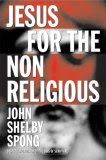
I'm currently reading John Shelby Spong's latest book, Jesus for the Non-Religious. Spong (not to be confused with former WCG minister Grant Spong) is an interesting chap. Despite being a retired Episcopal bishop of the liberal persuasion, his roots are fundamentalist, and that shows in his style of writing which beats around no bushes and pulls no punches. Whatever else this book may be, wishy-washy it isn't.
Several years ago Bishop Spong toured New Zealand and I was dragged along to hear him by a relative. I'm glad I went. I've read almost everything he's published, and hugely respect his raw honesty. Spong, unlike most of the bland, anemic types in mainline Christian leadership, is a scrapper. Lord knows the liberal church needs a lot more like him.

For many fundagelicals Spong is the devil incarnate as he threatens to toss out their much loved "treasure trove of beddy-bye stories" (to recall a memorable expression I once heard Garner Ted Armstrong use.) In this latest book he sets about to systematically deconstruct the Jesus of popular imagination, and by golly, he does a pretty thorough job. He also demonstrates quite conclusively that the gospel accounts are anything but literal history. Others have gone this way before, but they usually pussyfoot around lest offence be taken (and church funds dry up!), their work dying the death of a thousand qualifications.

People can respond to challenges like Spong's in one of two ways. They can circle the wagons and throw up a stockade of denial. Or they can look the challenge in the eye and deal with it with integrity. That may mean some painful growth but, what the heck, better to deal with reality than hide among the fluffy pillows and proof texts of self-deception. After the usual dose of bland confections doled out by the run-of-the-mill Bible-babblers and conformist clergy, Spong is like a fiery Indian curry. Be sure and have a large pitcher of cold water handy.

Thursday, 7 June 2007

Samuel and Saul, Pt.3


The issue in 1 Samuel 15 is a genocidal God. It takes special pleading to retrieve some decency from this disturbing tale, and the fact that some people even try indicates that their bibliolatry has long since moved beyond harmless wackiness into an apologetic for evil.

If we can cross our fingers and whistle through passages like this, what else will we ignore? They brought it on themselves? They were immoral? God has the right to take the life he has created? One is reminded of the advice the papal legate gave to the commander of the assault on the city of Beziers in 1209. How, the officer asked, are we to distinguish between the good Catholics and the wicked Cathars when we take the city? The legate reportedly replied: Kill them all, for God knows his own.

It is in revulsion to that kind of obvious evil that many of us fled from mainline Christianity to find something finer, more idealistic and truer in a sectarian community like the Worldwide Church of God. That quest may have ultimately proved a delusion, but the question remains: how can we make sense of sociopathic prophets like Samuel?

Some comfort might be found in the discovery that the historical books of Judges through Kings are relatively late creations, known to scholars as the Deuteronomistic History. The consensus is that they were created around the sixth century BCE, and that many of the events they relate are pure fiction. Not that most scholars were keen on the idea at first, but the archaeology of Israel just doesn't support the stories. Jerusalem was, for example, not a great city at the time David and Solomon were alive and the text is full of anachronisms such as the armour Goliath is described as wearing. At best David was a local warlord and Solomon a relatively minor figure. Saul? Who knows. A historical figure may well underlie the stories, just as real institutions like Opus Dei and the Louvre appear in Dan Brown's novel The Da Vinci Code. But history it is not, and nor are the Deuteronomist's accounts. The idea of history as an objective retelling of the past was still far in the future when 1 Samuel was written, or Homer's Odyssey for that matter.

The Samuel stories are, however, powerful narrative, and Saul is a tragic character: arguably the only truly tragic character in biblical literature. The man who is singled out - against his own will - for the honor of being Israel's first king, is again singled out as the enemy of God, rejected without hope of redemption, tormented with an evil spirit from the hand of Yahweh. The shy young man who hides from the kingmaker is fated to die, along with all his descendants, and be replaced by a brigand, protection racketeer, adulterer, mercenary and murderer who - in the final insult - will be described by the Deuteronomist as "a man after God's own heart."

For Saul it is, to say the least, tough luck. Reading these books in a literal, fundamentalist sense is to feel the need to call evil good. But on another level they are an invitation to grapple with some pretty intense issues, and that, I believe, is their abiding genius.